

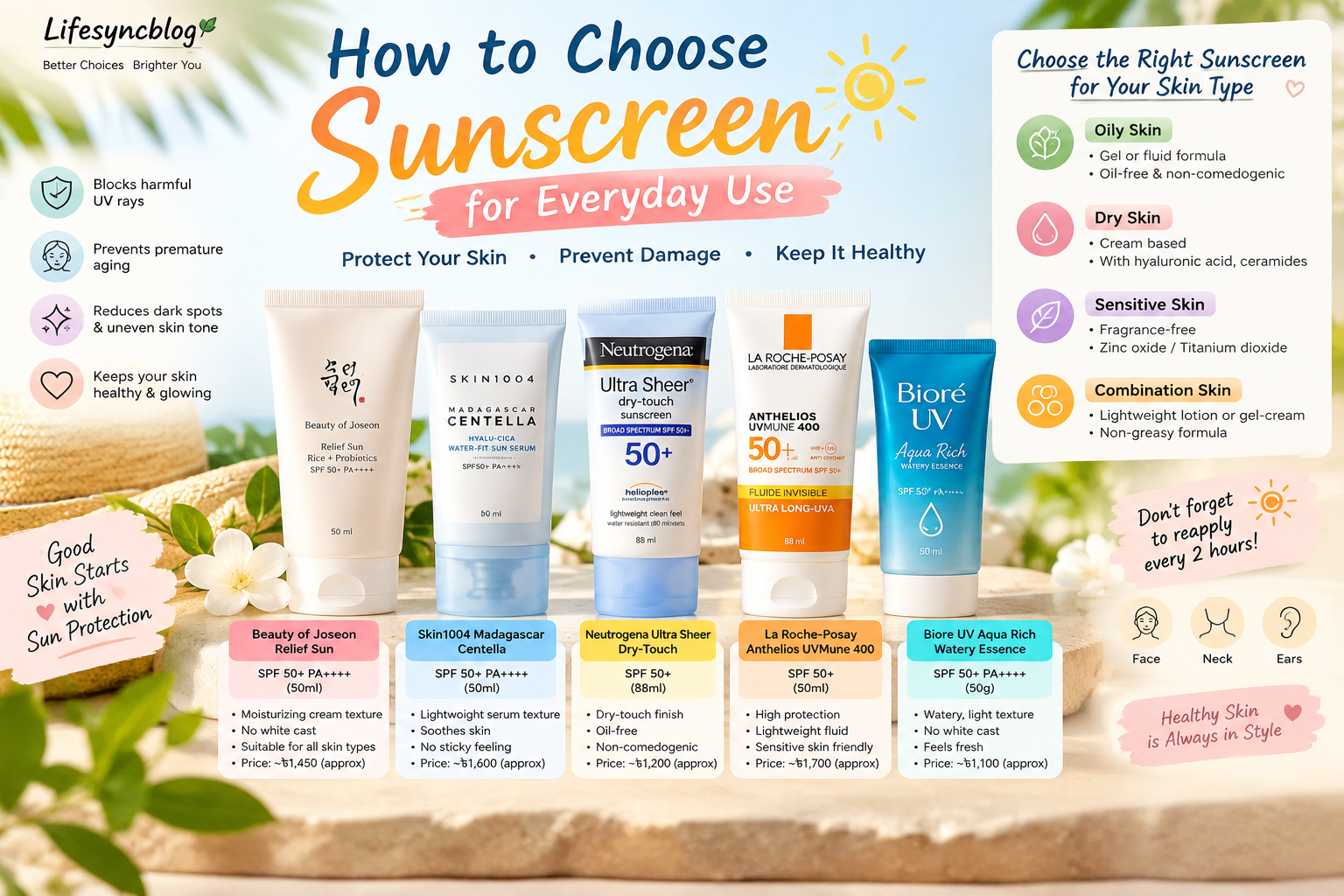
How to Choose Sunscreen for Everyday Use: A Complete Beginner’s Guide
Choosing the right sunscreen is one of the most important steps in a daily skincare routine. Whether you have oily, dry, sensitive, or combination skin, using the right sunscreen helps protect your skin from harmful ultraviolet (UV) rays.
However, with so many sunscreen products available, choosing the right one can be confusing. Some sunscreens feel greasy, others leave a white cast, and some may cause irritation.
Don’t worry! This beginner-friendly guide will help you understand how to choose the best sunscreen for your skin type, what ingredients to look for, and how to use sunscreen correctly every day.
Why Is Sunscreen Important for Everyday Use?
Sunscreen protects your skin from ultraviolet (UV) radiation, especially UVA and UVB rays.
Regular sunscreen use helps:
- Protect against sunburn.
- Reduce the risk of premature skin aging.
- Prevent and reduce worsening of dark spots and uneven skin tone.
- Protect skin from UV-related damage.
- Support healthier-looking skin over time.
Important: Sunscreen is not only for summer. UV rays can affect your skin throughout the year, even on cloudy days.
1. Choose Sunscreen with SPF 30 or Higher
SPF stands for Sun Protection Factor. It indicates how well a sunscreen protects against UVB rays.
Here is a simple guide:
- SPF 30: A good everyday option.
- SPF 50: Offers higher UVB protection.
- SPF 50+: A useful option for extended outdoor exposure.
For daily use, choose a broad-spectrum sunscreen with SPF 30 or higher.
Broad-spectrum protection means the product protects against both UVA and UVB rays.
2. Understand PA Ratings
If you see PA ratings on sunscreen packaging, they indicate the level of UVA protection.
- PA+: Some UVA protection.
- PA++: Moderate UVA protection.
- PA+++: High UVA protection.
- PA++++: Very high UVA protection.
For everyday use, SPF 30–50 with PA+++ or PA++++ is a good choice.
3. Choose Sunscreen According to Your Skin Type
Not every sunscreen works for every skin type. Choosing the right formula can make your daily skincare routine more comfortable.
For Oily Skin
If your face becomes shiny or greasy easily, choose:
- Lightweight sunscreen.
- Gel-based or fluid formula.
- Oil-free or non-comedogenic products.
Avoid very heavy formulas if they make your skin feel uncomfortable.
For Dry Skin
Dry skin needs a comfortable, moisturizing formula.
Look for:
- Glycerin.
- Hyaluronic acid.
- Ceramides.
- Cream-based sunscreen.
These ingredients can help support skin hydration.
For Sensitive Skin
If your skin becomes red, itchy, or irritated easily, look for:
- Fragrance-free sunscreen.
- Zinc oxide or titanium dioxide.
- Gentle formulas designed for sensitive skin.
Always patch-test a new product before applying it to your whole face.
For Combination Skin
If your forehead and nose are oily but your cheeks are dry, choose a lightweight lotion or gel-cream sunscreen that feels comfortable on your skin.
4. Mineral vs Chemical Sunscreen: Which Is Better?
There are two common types of sunscreen.
Mineral Sunscreen
Common active ingredients:
- Zinc oxide.
- Titanium dioxide.
Benefits:
- Often suitable for sensitive skin.
- Provides broad-spectrum protection when properly formulated.
- Can leave a white cast, especially on deeper skin tones.
Chemical Sunscreen
Uses UV filters such as:
- Avobenzone.
- Octocrylene.
- Octisalate.
- Other approved UV filters depending on the country.
Benefits:
- Often lightweight.
- Usually blends more easily into the skin.
- Available in gel, fluid, and lotion formulas.
Which one should you choose?
Neither type is automatically best for everyone. Choose a broad-spectrum sunscreen that suits your skin and that you will use consistently.
5. Recommended Sunscreen Products to Consider
Here are some popular sunscreen options to research before buying.
- Beauty of Joseon Relief Sun SPF50+ PA++++ – A moisturizing cream texture.
- Skin1004 Madagascar Centella Hyalu-Cica Water-Fit Sun Serum SPF50+ PA++++ – A lightweight serum-like texture.
- Neutrogena Ultra Sheer Dry-Touch SPF 50+ – A sunscreen with a dry-touch finish.
- La Roche-Posay Anthelios UVMune 400 SPF50+ – A high-protection sunscreen range.
- Biore UV Aqua Rich Watery Essence SPF50+ PA++++ – A lightweight watery texture.
Buying tip: Check the exact product, ingredients, expiry date, seal, and authorized seller before purchasing. Product availability and formulas may vary by country.
6. How Much Sunscreen Should You Apply?
Applying too little sunscreen can reduce the protection you receive.
For the face, a commonly used guide is approximately two finger lengths of sunscreen. The amount may vary depending on the product and your face size.
Remember to cover:
- Forehead.
- Both cheeks.
- Nose.
- Chin.
- Ears.
- Neck.
Do not forget exposed skin around the hairline and ears.
7. When and How Often Should You Apply Sunscreen?
Follow these simple steps:
- Wash your face with a gentle cleanser.
- Apply your moisturizer if needed.
- Apply sunscreen as the final step of your morning skincare routine.
- Apply it about 15 minutes before going outdoors if directed by the product label.
- Reapply approximately every two hours when outdoors.
- Reapply after swimming, sweating, or towel-drying, following the product instructions.
If you spend most of your day indoors, apply sunscreen in the morning, especially if you sit near windows or receive sunlight.
8. Common Sunscreen Mistakes You Should Avoid
Many people use sunscreen but do not get the best protection because of common mistakes.
Avoid these mistakes:
- Choosing sunscreen without checking SPF.
- Using too little product.
- Forgetting your neck and ears.
- Not reapplying when outdoors.
- Using expired sunscreen.
- Skipping sunscreen on cloudy days.
- Mixing sunscreen with moisturizer before applying.
- Assuming makeup with SPF always provides enough protection.
9. What If Sunscreen Makes Your Face Greasy or Causes White Cast?
This is a common problem, but you can solve it by choosing a better formula.
Problem: Greasy face
Solution: Try an oil-free, lightweight gel or fluid sunscreen.
Problem: White cast
Solution: Try a tinted sunscreen or a well-formulated chemical sunscreen that blends into your skin.
Problem: Burning or irritation
Solution: Stop using the irritating product. Choose a fragrance-free formula and patch-test before trying another sunscreen. If irritation continues, consult a dermatologist.
Problem: Sunscreen causes pimples
Solution: Try a lightweight, non-comedogenic formula. Remove sunscreen gently at the end of the day.
10. Budget-Friendly Sunscreen Buying Tips
You do not need to purchase the most expensive sunscreen to protect your skin.
Before buying:
- Check SPF 30 or higher.
- Look for broad-spectrum protection.
- Check the expiry date.
- Choose a formula suitable for your skin type.
- Buy from a trusted seller.
- Avoid suspiciously cheap products with unclear packaging or ingredients.
A sunscreen that suits your skin and that you can afford to use regularly is a better choice than an expensive product you rarely use.
Frequently Asked Questions (FAQs)
Q1. Can I use sunscreen every day?
Yes. Daily sunscreen use is recommended to protect exposed skin from UV radiation.
Q2. Which SPF is best for everyday use?
Broad-spectrum SPF 30 or higher is a good everyday choice. SPF 50 is another suitable option.
Q3. Should I apply sunscreen indoors?
It can be helpful, especially when you spend time near windows with sunlight exposure.
Q4. Can sunscreen remove dark spots?
Sunscreen does not directly remove existing dark spots, but regular use can help prevent them from becoming darker and support other treatments.
Q5. Can oily skin use sunscreen?
Absolutely! Choose a lightweight, oil-free or non-comedogenic formula.
Q6. Can I skip moisturizer if my sunscreen is moisturizing?
If your skin feels comfortable and hydrated, a moisturizing sunscreen may be enough for your morning routine.
Final Thoughts
Choosing the right sunscreen does not have to be difficult. Focus on broad-spectrum protection, SPF 30 or higher, a suitable formula for your skin type, and consistent daily application.
Remember, the best sunscreen is the one that protects your skin, feels comfortable, and fits your budget.
Start protecting your skin today for healthier-looking skin tomorrow!